
How to Check Criminal History in Monroe County
No official screen contains every Monroe County record. Begin with the court or agency most likely to have created the information. MiCOURT Case Search covers participating courts and is the best first stop for filed local prosecutions. Choose Monroe County's 1st District Court for misdemeanors and early felony proceedings, or the 38th Circuit Court for a felony after bindover. Search by party name or case number, then compare the court, middle name, dates, and case details before deciding that a result belongs to the intended person.
Keep the full legal name, middle initial, approximate date, and known court or agency close at hand. Similar names can produce false matches. A District Court felony file and a later Circuit Court file may describe the same prosecution, so they should not be counted as separate convictions. When the online docket lacks an image or an older case, contact the correct clerk for the filed document or a certified copy.
- Select the Monroe court in MiCOURT and choose a party-name or case-number search.
- Enter the known identifiers, then rule out matches from another court or person.
- Read each charge, event, status, disposition, and sentence instead of relying on the case label alone.
- Check the county inmate lookup for current custody and ICHAT for reportable statewide history.
- Ask the originating clerk, sheriff, or police agency for the source record when a result needs confirmation.
Monroe County's Four Record Keepers
Downtown Monroe places several custodians within a short walk, but their files remain separate. The 38th Circuit Court and 1st District Court operate at 106 E. First Street. The County Clerk keeps Circuit Court records and certified copies. One block away, the Monroe County Sheriff's Public Resources/Records Division and Main Jail operate at 100 E. Second Street. A city police department still keeps its own incident report even when the arrested person is taken to the county jail.
The county courts gateway shows the local court structure. The image below preserves that official access point.
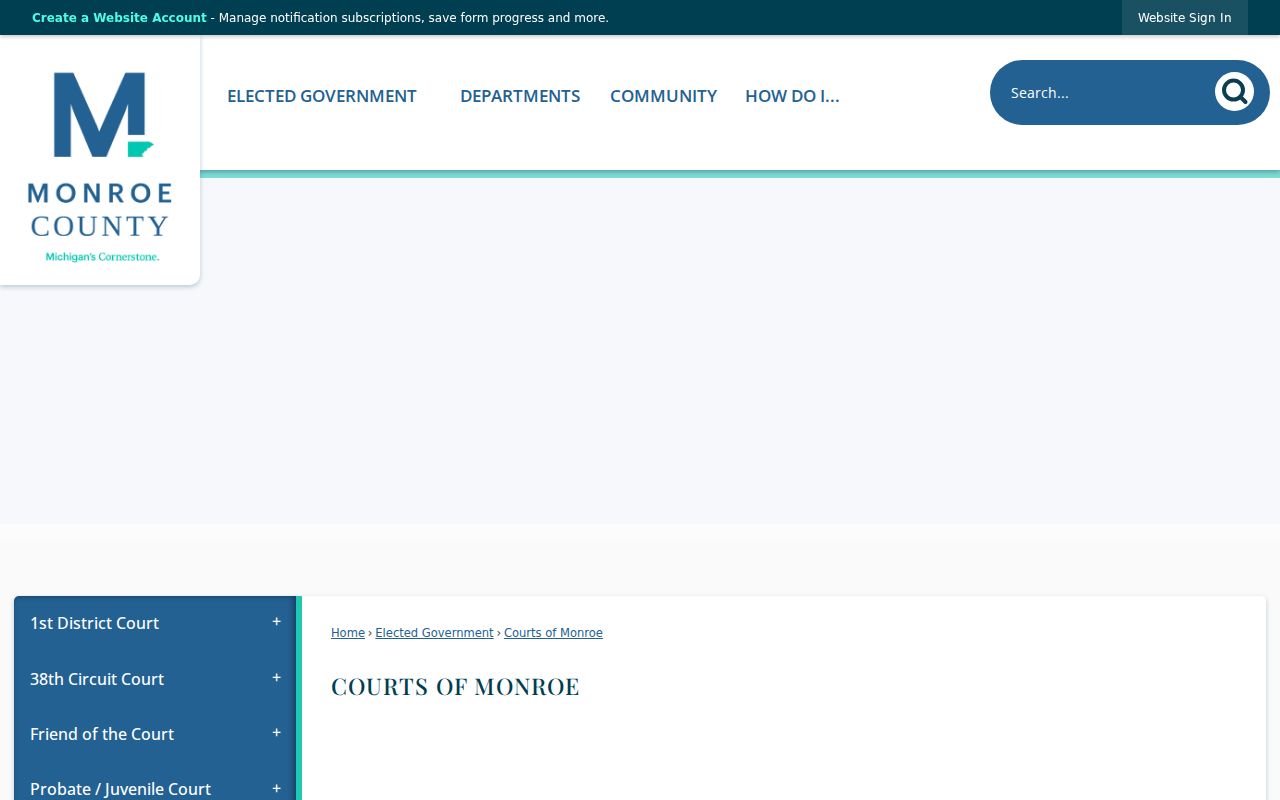
Use the courthouse for filed cases, the sheriff for sheriff-created reports and local checks, the jail for custody, and the arresting city department for its police report. The sheriff records counter is open all day, every day, while court and city counters keep business hours.
County Court Clerks
106 E. First St., Monroe, MI 48161
Circuit: 734-240-7020
District: 734-240-7075
Sheriff Records
100 E. Second St., Monroe, MI 48161
734-240-7415
Open 24 hours daily
Official Michigan Background Checks
The Michigan State Police Criminal Justice Information Center maintains the statewide repository. Its public criminal-history service routes name searches through ICHAT. A search costs $10 and requires an account, identifying details, and electronic payment. ICHAT reports qualifying Michigan felonies and serious misdemeanors submitted to the repository. It excludes warrants, federal and tribal matters, records from other states, juvenile cases, traffic matters, suppressed records, and local misdemeanors.
A name search is not a fingerprint match. For review or correction of one's own Michigan history, follow MSP's fingerprint instructions and use an approved Live Scan channel. The sheriff also advertises fingerprinting at its Records Division; call ahead about the appointment, identification, card type, and current local charge. Federal Identity History Summary requests are subject-only and use the FBI's separate fingerprint process.
The MSP criminal-history overview explains these choices, and the captured official page appears below.
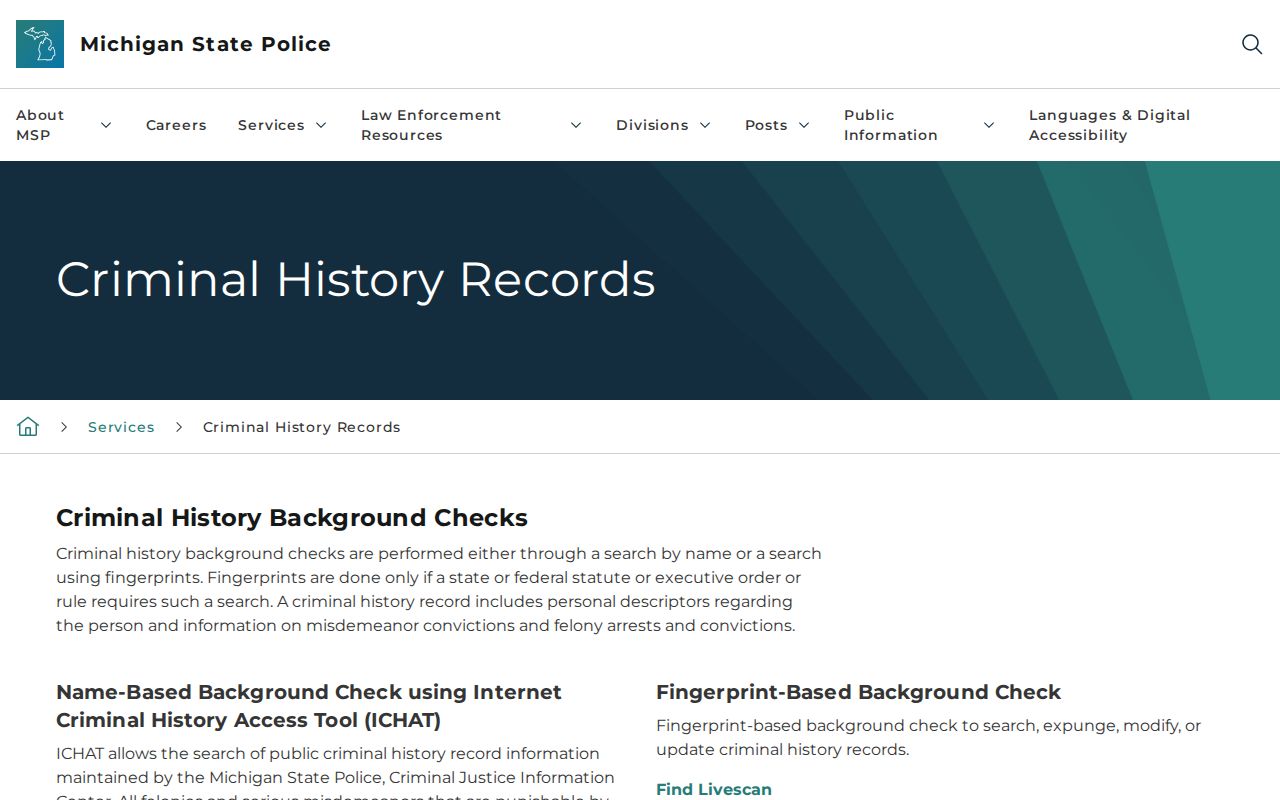
This state layer should supplement, not replace, a Monroe County court or agency search.
Monroe County Local Check Limits
The Sheriff's Records Division offers a $15 local records check. Walk-ins are handled at the continuous-service counter, and the office says a check commonly takes five to twenty minutes depending on what must be confirmed. Cash and cards are accepted. Card payments add a 3 percent convenience fee with a $2 minimum. Mailed requests are normally answered within five business days.
That product is not ICHAT. It reflects the sheriff's local record holdings rather than the statewide CJIC repository. A person reviewing a matter tied to Monroe Police, another city department, or a court must still contact that custodian. The official Records Division page shows the services and access details pictured below.
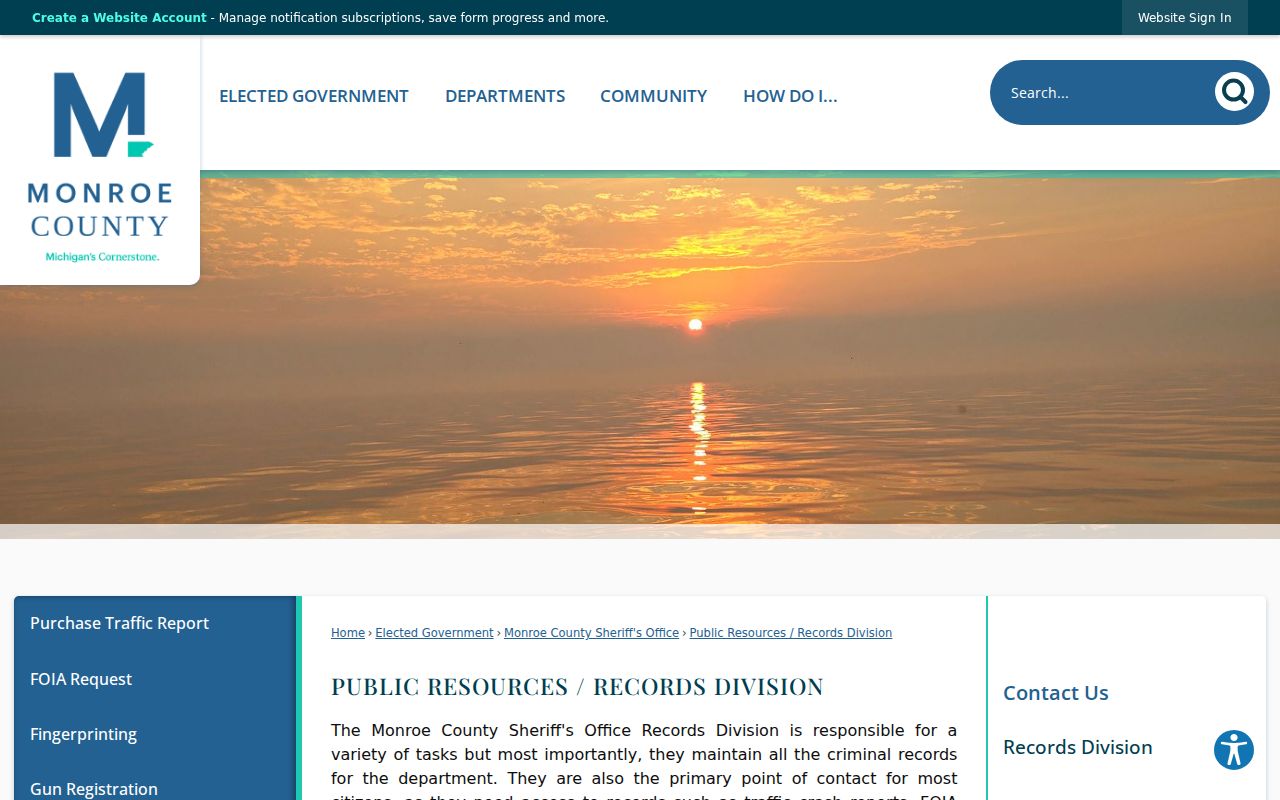
The local check is useful when its scope matches the question. It should never be described as a statewide report.
| Product | Published cost | Scope |
|---|---|---|
| Sheriff local check | $15 | Sheriff and local holdings |
| ICHAT name search | $10 | Reportable public Michigan history |
| FBI Identity History Summary | $18 before vendor fees | Subject-only fingerprint history |
Types of Criminal Records
A criminal event creates records in stages. Police document the incident and arrest. The jail records intake, custody, delivered charges, bond, and release. The prosecutor decides which charges to authorize. Court clerks then maintain the docket, pleadings, orders, outcome, and sentence. Fingerprints for reportable arrests flow to MSP, while later court dispositions connect the state arrest cycle to its result.
Other systems answer narrower questions. A warrant is issued by a court and shared through law-enforcement channels. MDOC maintains prison, felony probation, and parole information. MSP operates the public sex offender registry. Each source has different omissions and access limits.
- Arrest and booking records describe allegations and custody, not guilt.
- Criminal court case files document filed charges, hearings, outcomes, and sentences.
- Repository histories connect reportable fingerprint arrest cycles with court dispositions.
- Warrant records come from the issuing court and are not included in ICHAT.
- Supervision and registry records have distinct MDOC and MSP public systems.
Monroe County Jail or OTIS
The Monroe County inmate lookup covers current county custody. It can show a booking identifier, date, arresting agency, delivered charges, bond or hold, facility, release information, and a photograph when policy permits. If a name is absent or the portal is unavailable, call the Main Jail inmate line at 734-240-7430. The separate Dormitory Facility is at 7000 E. Dunbar Road, but callers should confirm which location handles the needed service.
MDOC's OTIS search serves a different population: state prisoners, parolees, felony probationers, and people discharged from MDOC within the last three years. The official OTIS access page is shown in the image.
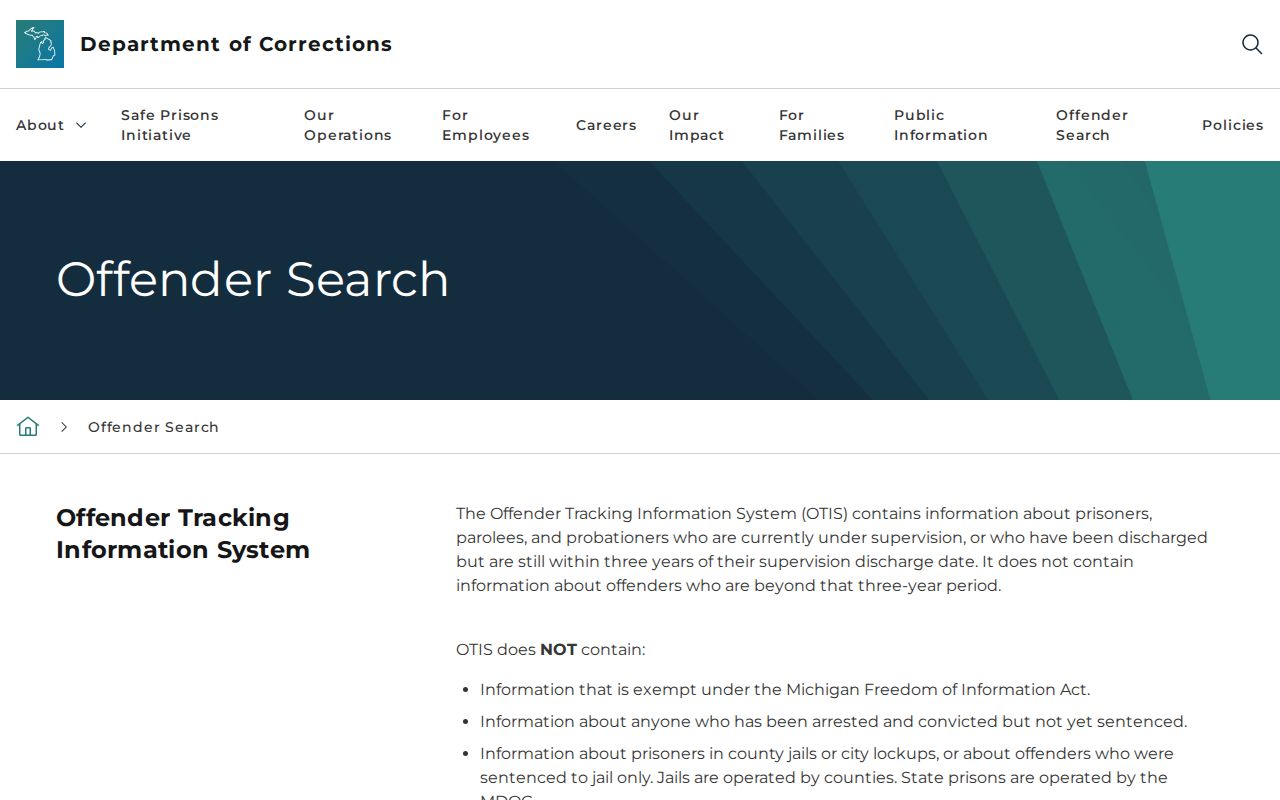
OTIS omits county-jail-only custody and older MDOC discharges. When custody may be federal, use the Federal Bureau of Prisons locator instead. Start in the system tied to the type of sentence or custody.
Note: A county booking charge may change after prosecutor review, so compare it with the later court docket before drawing a conclusion.
What a Monroe County Criminal Record Shows
The fields depend on the custodian. A state history emphasizes identity and fingerprint arrest cycles. A court file adds procedural detail. A jail record focuses on present or recent custody. Read field labels in context and distinguish an allegation from a final disposition.
| Name & Identifiers | Legal name, aliases, limited descriptors, state or booking numbers, and fingerprint transaction identifiers where applicable. |
|---|---|
| Arrest / Booking Data | Arresting agency, arrest and booking times, intake charge, bond, facility, and release status. |
| Charges & Statutes | Count description, Michigan statute citation, offense class, and filed charging document. |
| Disposition | Pending, dismissed, acquitted, or convicted outcome for each count. |
| Sentence | Jail or prison term, probation, fines and costs, restitution when public, and time-served credit. |
| Custody / Supervision Status | County custody, MDOC prison, probation, parole, release, or discharge information within the source's scope. |
Monroe Felonies Create Two Dockets
A felony begins in 1st District Court with arraignment, a probable-cause conference, and a preliminary examination unless that step is waived. If probable cause supports the charge, the matter is bound over to the 38th Circuit Court. The prosecutor then files an information in Circuit Court, where the case proceeds through circuit arraignment, motions, plea or trial, and any sentence.
That move creates two court numbers for one prosecution. MiCOURT users should read the District disposition carefully. A bindover does not mean the charge ended, and the Circuit file may hold the final result. Conversely, a dismissed count can appear beside a conviction on another count. The Monroe County criminal court case search explains the local docket path and clerk access in greater depth.
Case flow: Police investigation → prosecutor review → District Court complaint → bindover → Circuit Court information → disposition.
Public Access Laws
Michigan law provides several access routes, but each has limits. FOIA applies to public-body records and permits exemptions for protected information. Court records follow Michigan Court Rule 8.119. ICHAT and the public registry operate under their own statutes. Juvenile, sealed, set-aside, victim, minor, and active-investigation material may be withheld or redacted.
Key Statutes:
Michigan FOIA, MCL 15.231 et seq. establishes access to public-body records subject to exemptions and fee rules.
MCL 28.242a authorizes public criminal-history access through ICHAT.
Michigan Court Rule 8.119 governs public and nonpublic court records and redaction.
MCL 780.621 controls application-based conviction set-aside eligibility.
Monroe County Warrant Confirmation
ICHAT does not include warrants, and research found no dependable countywide public active-warrant database. For a District or Circuit matter, inspect MiCOURT for a public warrant or capias event, then call the issuing court to confirm status. Sheriff Records can also be reached at 734-240-7415. A narrow sheriff FOIA request may retrieve releasable material, but active or sealed law-enforcement information can be withheld.
Bench warrants often follow a failure to appear or comply. Arrest warrants arise from a supported criminal complaint, while search warrants authorize a search of a place or property. An online absence does not clear any warrant. A person addressing their own possible warrant should obtain the case number and follow the issuing court's appearance, bond, or surrender directions.
Note: Dundee's official wanted page contains visibly old entries, so any listing there requires direct agency confirmation before reliance.
Sealed, Expunged & Restricted
Michigan uses both “set aside” and “expungement.” Juvenile records, successful HYTA matters, court-sealed files, qualifying set-aside convictions, victim and minor identifiers, and some active investigative records do not appear like ordinary adult public records. A set-aside generally makes a conviction nonpublic while preserving limited justice-system access allowed by statute.
Automatic Clean Slate relief and an application-based set-aside are separate paths. Application eligibility, exclusions, waiting periods, and filing steps depend on the conviction. Monroe applicants obtain a certified conviction record from the sentencing court, follow MSP fingerprint directions, file in the court of conviction, and send required copies as current instructions require. No public screen should be used to promise eligibility or immediate removal.
Correcting Monroe County Record Mismatches
First identify the source of the mismatch. A jail intake charge may differ from the prosecutor's authorized count. MiCOURT may show a judicial entry that has not yet reached ICHAT. A set-aside order may also take time to propagate across official systems. Compare the questionable state entry with the sentencing court's certified disposition before asking MSP to change repository data.
Judicial errors belong with the court. MSP provides the RI-027 Judicial Correction Worksheet for court use, while fingerprint or identity challenges go through CJIC. Keep the certified order, transaction or control identifiers, and any response. If an official source still displays a cleared record, send the order to that record holder and follow its correction channel.
The Monroe County Sheriff's official page provides the county law-enforcement contact shown below.
The sheriff can address sheriff-created records, but only the court can correct its judgment and only MSP can correct its repository entry.
Monroe County Recovery Court Entries
Monroe County has named problem-solving courts: 1st District Veterans Treatment Court, 1st District Mental Health Recovery Court, and 38th Circuit Adult Drug Treatment Court. Their dockets can contain recurring reviews, compliance events, and program status entries. Those entries are not new criminal charges merely because they appear as additional hearings.
Read each event beside the case number, charge disposition, and current status. Treatment-court participation may be connected to a pending case, sentence, or program-specific path. When a docket label is unclear, ask the clerk for the underlying public order rather than infer a new arrest or conviction. This local detail prevents the kind of double counting that can occur when someone reads only an event list.
Physical location can help with an older or non-imaged entry. The 1st District and 38th Circuit counters share the court building at 106 E. First Street, but each clerk controls its own file. The Erie Satellite Court at 12277 S. Telegraph Road provides another district location for scheduled services. Call the assigned court first, especially when a treatment review, accommodation request, mailed filing, or certified copy is involved. A hearing display gives schedule information, not the full case record.
Criminal Records by City in Monroe County
City police departments keep the reports they create, but court and jail routing can cross city and county lines. Monroe is the county seat. Flat Rock lies mostly in Wayne County with a small Monroe County portion, while Milan spans Monroe and Washtenaw counties. In both split cities, the exact incident location determines which county court or jail holds the next record.
The official Census profile for Monroe city supplies the local population context captured below.
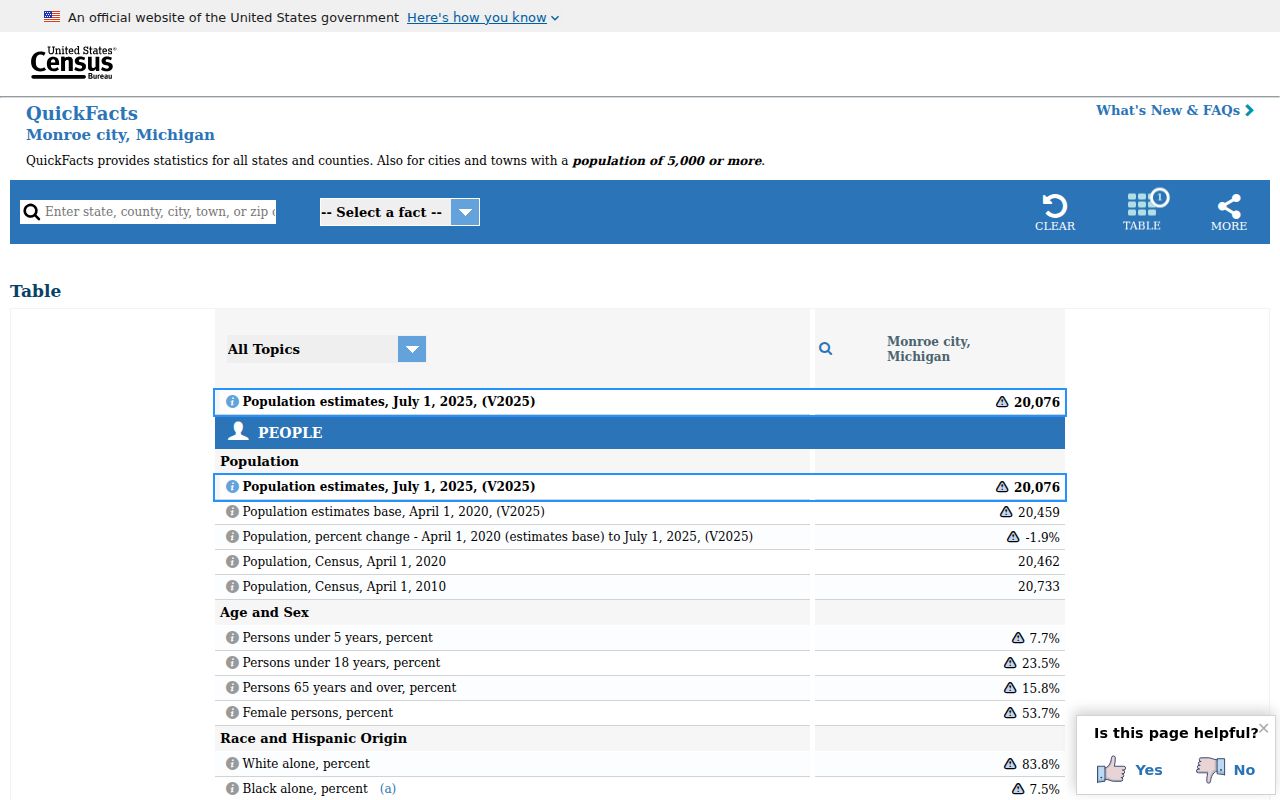
These city guides begin with the municipal police report, then route the reader to the correct county custody and court channel.
Monroe Criminal History
County seat · City police reports route through the Monroe Police Records Bureau.
Flat Rock Criminal History
10,541 total in 2020 · Incident location determines Monroe or Wayne County routing.
Milan Criminal History
6,079 total in 2020 · Records may route through Monroe or Washtenaw County.