
Criminal Cases in the Monroe County Courts
Monroe County divides criminal cases by jurisdiction and stage. The 1st District Court handles misdemeanors, traffic matters, felony arraignments, probable-cause conferences, and preliminary examinations. When a felony is supported by probable cause, the matter is bound over to the 38th Circuit Court. Circuit Court is the felony trial and sentencing court and also hears appeals from District Court. Appeals from Circuit Court proceed to the Michigan Court of Appeals.
Both Monroe County courts operate at 106 East First Street in Monroe, but each keeps its own part of the record. The Monroe County District clerk holds misdemeanor files and early felony dockets. The County Clerk is custodian of filed Circuit Court records. A searcher following one Monroe County felony may therefore need both court numbers. The Erie satellite at 12277 South Telegraph Road supports services and problem-solving work as scheduled, but it does not replace the correct clerk for the underlying file.
The official Monroe County 1st District Court source shows where the lower-court path begins.
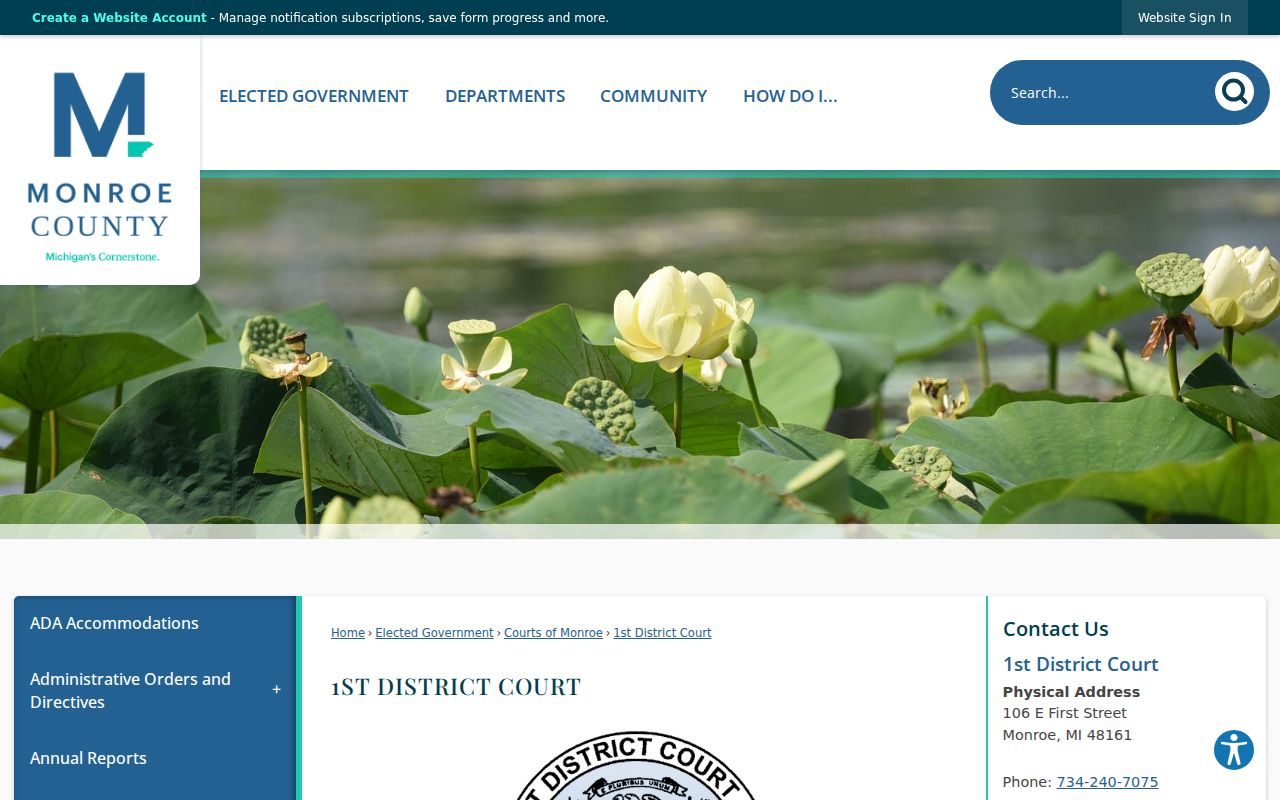
This Monroe County court is the key first stop for a misdemeanor or a felony that has not yet been bound over.
Why Monroe Felonies Have Two Dockets
A Monroe County felony often begins with a complaint and arraignment in District Court. The probable-cause conference lets the parties address the proof, scheduling, and possible resolution. If the case proceeds, a preliminary examination tests whether probable cause supports the charge. A bindover then sends the felony to Circuit Court, where the prosecutor files an information and the court conducts another arraignment.
That Monroe County transfer can produce two related case entries. It does not mean there were two convictions. Compare the defendant identifiers, filing sequence, charge text, and event dates. The Monroe County District docket records the preliminary stages, while the Circuit docket records the felony trial-level path. Treatment-court reviews can also create repeated status entries. Those entries are review hearings in an existing matter, not fresh charges.
Record flow: District complaint › probable-cause conference › preliminary examination › bindover › Circuit information.
How to Search Case Records
MiCOURT Case Search is the main public online channel for Monroe County criminal court cases. A Monroe County search should use the 1st District Court for misdemeanors and preliminary felony stages. Search the 38th Circuit Court for felonies after bindover. Coverage varies by participating court and case type, and online docket data is informational rather than a certified court record.
- Open MiCOURT and choose the court search.
- Select Monroe’s 1st District Court or 38th Circuit Court.
- Choose Party Name or Case Number, then enter known identifiers.
- Open likely matches and compare the court, middle name, dates, charges, and status.
- Ask the proper clerk for document images, older files, or certified copies.
| Field Label | Type | Required | Notes |
|---|---|---|---|
| Court | Selector/search | Yes | Choose 1st District or 38th Circuit |
| Search Type | Control | Yes | Party Name or Case Number |
| Last Name/Business Name | Text | For name search | Use the legal spelling |
| First and Middle Name | Text | No | Useful for common names |
| Case Number | Text | For number search | Enter the local court number |
| Case Type | Filter | No | Choose Criminal when available |
The official MiCOURT search screen illustrates the court and search-type controls used for a Monroe County case query.
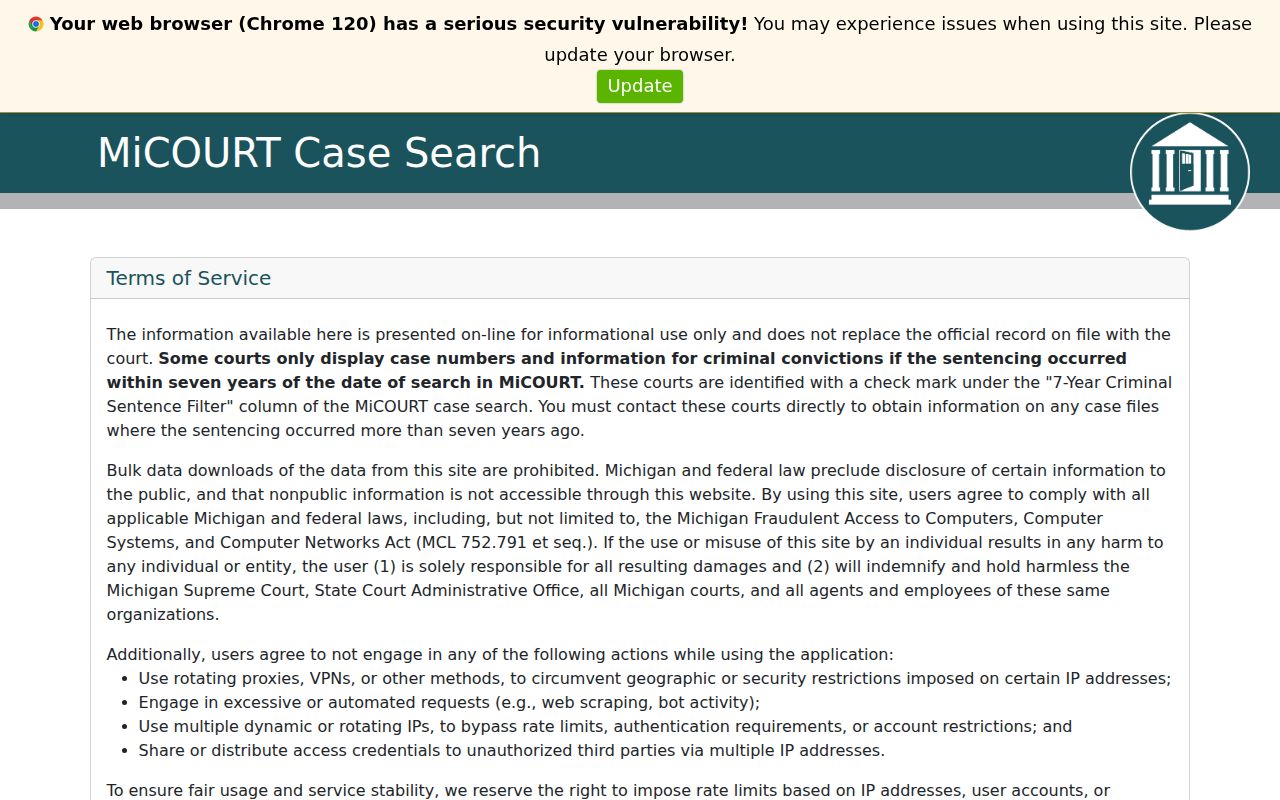
Careful Monroe County court selection prevents a District file from being mistaken for the later Circuit record.
Reading Monroe County Hearing Displays
The public Monroe County 38th Circuit hearing display answers a narrow question: when and where a listed hearing is set. A row may show the hearing date and time, case number, judge, location, and a CTN when present. It is useful for schedule checks, but it is not a full criminal-history report and does not replace the case detail.
Open the matching Monroe County MiCOURT docket to review filed events and the result of each count. A hearing can move, and a row does not prove that a hearing occurred as first set. Court pages identify Circuit judges by floor, with Judges Nichols and White on the third floor and Judge Braunlich on the fourth. Confirm the current room and access details with the court before an in-person trip.
The official Monroe County 38th Circuit public display shows the schedule-focused format.
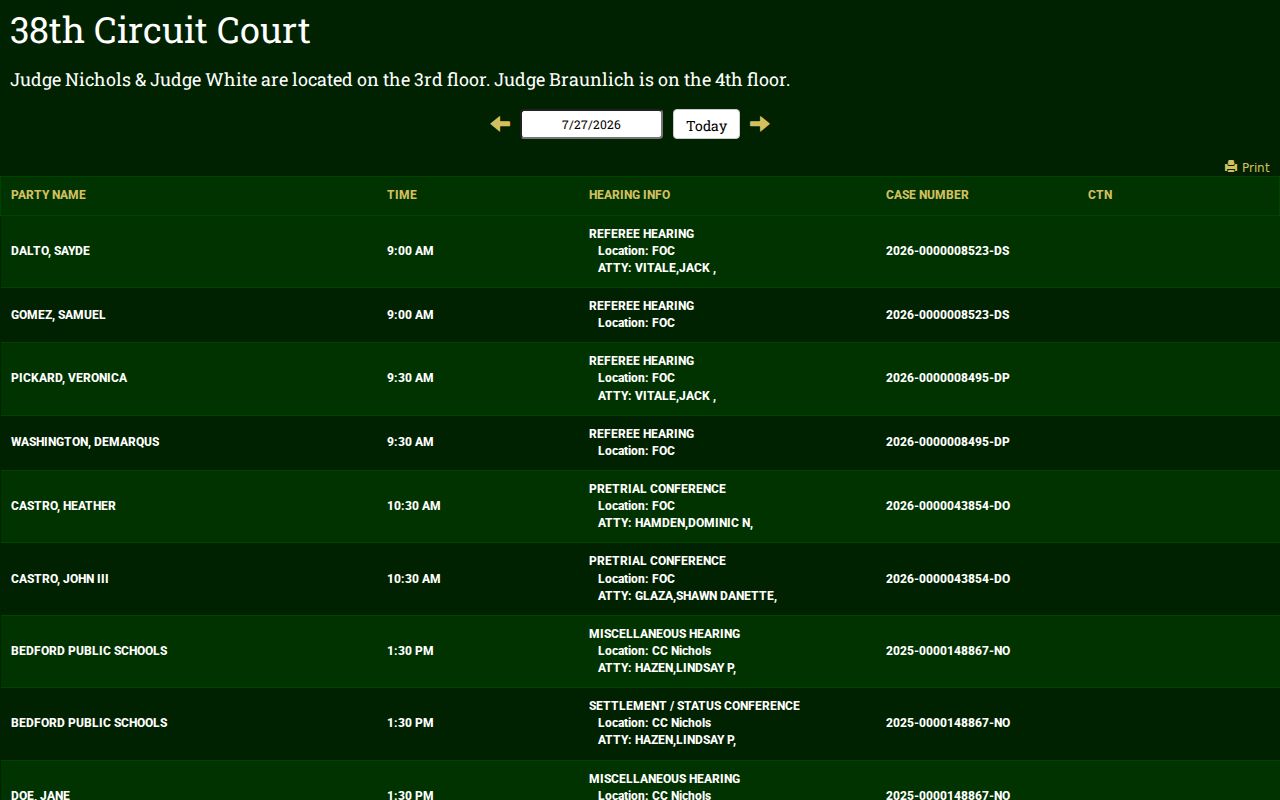
Use those Monroe County rows as a calendar aid, then return to the docket and clerk for the case record itself.
What the Case File Shows
A Monroe County court file is richer than a jail entry or public ICHAT result. MiCOURT can expose docket metadata, while filed Monroe County pleadings and orders remain with the clerk. The public view may include a defendant, prosecutor, public attorney information, count descriptions, statutes, events, results, and sentence data. It can also show fines, costs, restitution when public, custody terms, probation terms, and credit for time served.
| Case Number & Court | Identifies the local file, court level, case type, filing date, status, and judge. |
|---|---|
| Charging Document | The complaint starts many cases; an information states bound-over felony charges in Circuit Court. |
| Docket Entries | Lists filed events, motions, conferences, pleas, trial activity, orders, and review hearings. |
| Hearing Dates | Shows scheduled proceedings, with time and location when public. |
| Disposition & Judgment | Records the result of each count, which may differ within one case. |
| Sentence & Conditions | May show jail, prison, probation, fines, costs, restitution, and credit. |
A charge description is not its result. A dismissed count can sit next to a conviction on another count, and “closed” does not by itself mean guilty. For a fuller view of how arrest and statewide history differ from a case file, use the broader Monroe County criminal history overview.
Monroe Criminal Docket Terms
Michigan’s court terms mark distinct acts in the life of a Monroe County case. Reading them in order helps a searcher avoid treating an interim entry as the final result. A plea is the defendant’s formal response, while a disposition is the outcome of a charge. A sentence follows a conviction and states the court’s order.
- Bindover
- Transfer of a felony from District Court to Circuit Court after probable cause is found or examination is waived.
- Dismissal
- End of a count or case without a conviction on that count.
- Disposition
- The final result recorded for a charge or case.
- HYTA
- A protected Michigan youthful-trainee status that can end as a non-conviction after successful completion.
- Bench warrant or capias
- A court command to arrest, often tied to a failure to appear or comply.
The most reliable reading pairs each count with its own disposition and then checks the judgment or sentence. Do not infer the result from one status word at the top of the file.
Stages of a Criminal Case
The Monroe County Prosecuting Attorney describes a local path that begins with police investigation and prosecutor review. If charges are authorized, a warrant or complaint leads to arraignment. A felony stays in District Court for the probable-cause conference and preliminary examination unless it resolves or is dismissed. After bindover, Circuit Court handles arraignment on the information, motions, pretrial work, plea or trial, and sentence where there is a conviction.
Case flow: Charges Filed › Arraignment › Pretrial › Plea or Trial › Disposition › Sentencing.
The county’s Steps in a Prosecution source puts these events in local order.
Matching Monroe County docket entries to that sequence makes it easier to tell what has happened and what may still be pending.
Certified Monroe County Court Copies
Online Monroe County entries do not guarantee free images of the complaint, information, plea, judgment, or order. The Monroe County Clerk holds Circuit Court filings and provides the path to certification. The Circuit records contact is at 106 East First Street, Monroe, with phone service at 734-240-7020. District Court can be reached at 734-240-7075 or 734-240-7076 for its misdemeanor and early felony files.
Ask for the exact Monroe County record by court and case number. State whether a plain or certified copy is needed and whether the file is older or not imaged online. The County Clerk states that filings may also move by mail or drop box. An authoritative online fee schedule for copies and archive searches was not found, so confirm the cost and payment method with the proper clerk before ordering.
38th Circuit Court Clerk
106 E. First St.
Monroe, MI 48161
734-240-7020
1st District Court
106 E. First St.
Monroe, MI 48161
734-240-7075 or 734-240-7076
The official County Clerk record source helps distinguish filed Circuit Court papers from a screen result.
A certified copy bears the clerk’s authority; a printout of a public docket does not.
Access & Restrictions
Michigan Court Rule 8.119 defines court records and supports public access while recognizing nonpublic records and redaction. Monroe County public views exclude Social Security numbers, full personal identifiers, and protected victim or minor information. Juvenile files, sealed matters, set-aside cases, HYTA records, and other records made nonpublic by law or court rule will not appear like an ordinary adult criminal docket.
A missing Monroe County criminal case should prompt a check of the spelling, court, and case number. Next, ask the District or Circuit clerk whether the case is older, not imaged, transferred, or nonpublic. Monroe County court files are obtained from the clerk rather than through an ordinary county FOIA request. The Michigan Freedom of Information Act is the route for many executive-agency records, but court records follow the court-access rules.
The official 38th Circuit Court page provides the local felony-court access point.
When the screen and clerk differ, the clerk’s filed record and certified copy are the authoritative sources.
Monroe Court Reviews and Appeals
Not every repeated Monroe County hearing signals a new case. The county operates 1st District Veterans Treatment Court and Mental Health Recovery Court, along with Circuit Adult Drug Treatment Court. These programs may create review hearings and status entries under the same matter. Read the case number and event label before deciding that a fresh charge was filed.
Monroe County appeal routes also depend on the court that entered the ruling. District Court appeals go to Circuit Court. Circuit Court appeals go to the Michigan Court of Appeals. The Monroe County docket can show that an appeal began, but the appellate court holds its own record. This distinction matters when a later decision changes a judgment or sends an issue back to the Monroe court.
The county’s Circuit Court information places felony trials, District appeals, and specialty-court work in the right local setting. Follow the case number and court level, not just the number of hearing entries.